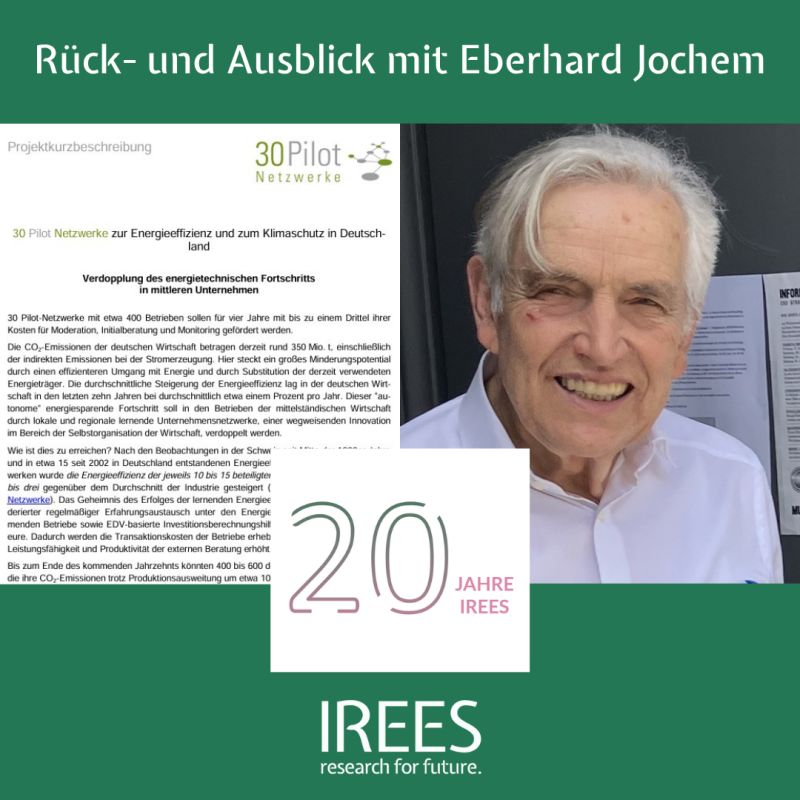
20 Years of IREES: Lightning Interview with Eberhard Jochem
Eberhard Jochem, at IREES since its founding in 2006, in our lightning interview:
1️⃣ Eberhard, what do you do at IREES?
Between 2006 and 2014 I was managing partner. We started out as five researchers in a three-room office in the basement of a former hairdressing salon. By mid-2014 we had three business units covering applied research and transfer acceleration. Turnover had quadrupled and the number of staff had tripled. It was a successful build-up of a Fraunhofer ISI spin-off.
Today I analyse in particular the potential of new industrial processes aimed at lower specific energy demand and defossilised production. In doing so, I am greatly concerned that R&D results are reaching broad industrial application — and subsequently export markets — too slowly. In competition with China, this reduces the net exports of the German economy and thus cuts into Germany’s national income.
2️⃣ Which favourite project has stayed with you?
My favourite project was the “30 Pilot Networks” project ([link]). From 2010 onwards, our task was to establish 30 energy efficiency networks as quickly as possible with partners we knew well (including EnBW, Eproplan, FfE, FUU and ÖKOTEC) and to run them for three to four years following the “learning networks” format. The results across roughly 360 companies were outstanding: together they achieved an average of 10% energy savings within five years — that is, above-average reductions in energy costs and CO₂ compared with companies not taking part in such networks. Specifically, they doubled their efficiency gains through exchanging experience and spurring one another on. Thanks to the use of combustible waste and the purchase of green electricity, the CO₂ reduction was higher still.
3️⃣ What has changed in the energy sector since then, and how do you look ahead?
In the energy sector, the focus in science and policy has been too heavily on energy supply in recent years. Using energy more efficiently and more flexibly has been neglected — in contrast to Scandinavia or Switzerland. IREES today has a competent and committed team of a kind I would not have expected ten years ago.
Looking ahead, I view EU and German energy policy with some concern; it is increasingly guided less by scientific and technical facts and more by the opinions of insufficiently informed voters. This lack of fact-orientation unsettles investors, and decisions are often postponed or made wrongly. Shrewd importers are only too pleased about that as they prepare to take over new markets in Europe — electric cars and electrolysers now, air conditioning tomorrow.
IREES – RESEARCH FOR FUTURE 🌍🍃